CuteCanonCapture Snaps Photographs via USB

CuteCanonCapture Snaps Photographs via USB – Digital Cameras – Lifehacker

I’n not sure that this does anything that can’t be done by the software that comes with your camera but if you’re a Canon shooter, you might want to take a look.

Windows only: Free Windows application CuteCanonCapture turns your computer into a remote trigger for your Canon digital camera.

Provided you’ve got a supported Canon camera (see below), you just plug your camera into your computer via USB, fire up CuteCanonCapture, and you can snap pictures remotely, tweaking exposure, flash, focus, and zoom all from the comfort of your keyboard

Winning Entries From Scott Kelby’s Worldwide Photo Walk Announced!

Photoshop Insider Blog By Scott Kelby » Blog Archive » Winning Entries From Scott Kelby’s Worldwide Photo Walk Announced!

This was incredibly hard. Even harder than I thought.

Last year it was really tough coming up with my finalists and winner, but this year’s judging was more than just four times harder—not just because four times as many people participated—but because the sheer quality of the shots this year was just over the top.

There were so many amazing, intriguing, fascinating, and just fun shots, that it made going from nearly 900 shots down to 10 finalists and one winner incredibly challenging. But, instead of keeping you waiting; let’s get to the winners, and we’ll talk more in a moment.

Newsletter from Cape Photographic Company

Peter Haarhoff of Cape Photographic Company e-mailed this newsletter that may be of interest to members.

Hello Helderberg Photographic Society

I think there is something magical about taking photographs at night, something that is often lacking in normal daylight photographs, but as the sun goes down, it becomes harder to capture stunning images without the proper equipment and techniques.

Here are a few pointers to help you take good night time photographs:

USE LONG EXPOSURES
The key to successful night photography lies in long exposures. The problem with long exposures is that you might move the camera during the exposure, resulting in blurry pictures. The way around this is to use a tripod. I prefer to use a tripod and a cable release fitted to my camera, just to make sure I do not move the camera at all during the long exposure.
If you do not have a cable, or shutter release for your camera, try using the camera’s self timer instead.

NOISE REDUCTION MODE
Use your camera’s “Noise Reduction Mode” to reduce the effect of noise on your photographs, if you are not sure whether your camera has a feature like this, refer to your instruction manual, or send me a email and I will check for you. If your camera does not have a “Noise Reduction Mode”, try using a very low ISO setting. That will also help to reduce noise.

HOW TO USE THE FLASH
As a general rule, I turn the flash off when taking scenic photographs at night. There are some exceptions though- one specific example I can think of is when you want take a photograph of a person, showing beautiful lights in the background. You then need to use your camera’s flash to light up the person, combined with a slow shutter speed to capture the beautiful lights in the background.

TRY TO CAPTURE MOTION
With a long exposure, you have many creative options available, like capturing motion. For example, have you ever wondered how those professional photographers take pictures of cars at night with the lights trailing behind? It’s all done with a long exposure. Try to keep this in mind next time you’re taking a night photo- you don’t have to restrict yourself to still images.

TIP FOR BEGINNERS
Try using your camera’s “Night Time Mode”, this is normally indicated by a half moon, or buildings with stars, or even a flash off icon on your camera. Simply select this mode, place your camera onto a tripod, and…there you go!

INTERESTED TO LEARN MORE…
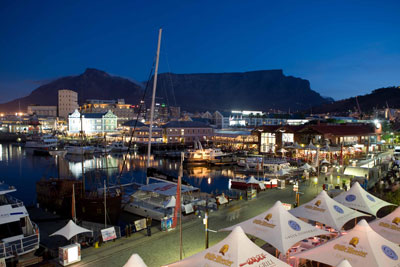
JOIN THE “DON’T BE AFRAID OF THE DARK” PHOTOGRAPHIC WORKSHOP AT THE V&A WATERFRONT ON SATURDAY 29TH OF AUGUST 2009 FOR ONLY R150 per person

LIMITED SPACE AVAILABLE!
FORTHCOMING PHOTOGRAPHIC WORKSHOPS
29 August 2009 – “Don’t be afraid of the Dark” at the V&A Waterfront
Learn how to take stunning photographs at night with long exposures

5 September 2009 – “It’s the motion of the ocean” on Blouberg Strand
Learn how to use a slow shutter speed, to capture the blur of moving water

18 September 2009 – “Paint with light” Workshop in Johannesburg
Learn how to take photographs using the ‘bulb’ setting on your camera,
while ‘painting’ interesting patterns using multi-coloured torches

26 September 2009 – “How to take better portrait photographs” in Stellenbosch
Learn the techniques needed for top portrait photographs

PHOTOGRAPHIC DAY TRIPS
Learn how to use your camera, and to take better photographs, on a photographic day trip in the Western Cape. Here are the most popular photographic outings:

TABLE MOUNTAIN & CITY
CAPE POINT & CAPE OF GOOD HOPE
CAPE WINE LANDS
MACRO or CLOSE-UP
WEST COAST FLOWERS
MOUNTAIN PASSES PANORAMIC TOUR
PORTRAIT AND PEOPLE TOWNSHIP EXPIERIANCE
SHIPWRECKS AND LIGHTHOUSES
BAD WEATHER AND RAINY DAYS

A MOMENT IN TIME…

This photograph of the Clock tower, in the Victoria Basin was taken by well known Cape Town photographer Arthur Elliott (1870-1938), probably not much later 1900. The quaint, pinnacled late Victorian clock tower, built in 1883, was the focal point of Cape Town’s harbour, and can still be seen today in the now V&A Waterfront. The photograph was taken with a quarter-plate camera, given to Arthur by a friend.

THOUGHT FOR THE DAY
“Wisdom suggests that you seek the positive in every person and situation and cultivate an attitude of gratitude.”

Keep those cameras snapping, till next time.

Peter Haarhoff

0 8 2 8 5 3 9 9 3 9
photocoach@mweb.co.za
www.capephotoco.co.za

August Competition Winners

Here are the winners of the August competition for which the set subject was 2010.

Please note that only digital images are available for display.

Prints

Set Subject

  1. Future Women’s Bafana Bafana Player
    Paddy Howes
  2. The Balancing Act
    Paddy Howes

Open

  1. Oblique Lines
    Paddy Howes
  2. Splash
    Kina Joubert
  3. Skoorsteenveêr 2
    Neels Beyers

Projected Images

Set Subject

  1. The taxi’s waiting
    Nettie Warncke
  2. Getting Ready
    Chris Joubert
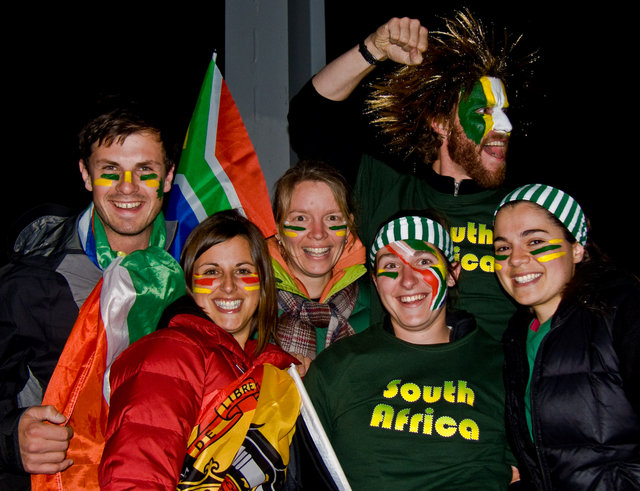
  3. Fabulous Fans
    Gavin Whiteford

1. The taxi's waiting2. Getting Ready3. Fabulous Fans

Open

  1. On our way
    Marthinus Retief
  2. Persimmon Tree
    Nicole Palmer
  3. Vliemasjien
    Neels Beyers

1. On our way2. Persimmon Tree3. Vliemasjien

DNG, RAW and JPEG: What I Use & Why

DNG, RAW and JPEG: What I Use & Why » JMG-Galleries – Jim M. Goldstein Photography

Almost 5 years ago I wrote an article on the pros and cons of using RAW versus JPEG and why I was shooting in RAW (see RAW vs JPEG: Is Shooting RAW Format For Me?). These days the argument of using RAW versus JPEG is well… not an argument at all. Most photographers realize that shooting in RAW provides a great number of benefits and many if not all the reasons to avoid using RAW have been nullified thanks to a variety of technical innovations including larger capacity compact flash drives & hard drives, maturation of RAW converters, development of photo specific editing/management software and faster more powerful computers. Now the question that faces photographers is should I convert my RAW files to DNG?

Teaching Through Photography

Photograh taken by a child taking part in CHOSA's photography workshops.I was recently contacted by Ellen Rosenberg who runs CHOSA, a small NGO based out of Cape Town that provides support for children’s homes, creches and outreach projects for orphans and vulnerable children. They work with communities to provide support, primarily in Khayelitsha, Nyanga, Mfuleni, Delft, etc.

Since 2006, they have been running photography workshops with the youth in their after-school program. They use point-and-shoot 35mm cameras and teach everything from “which way to hold the camera” to composition, lighting, subject and more. These workshops have been featured on NPR’s The Picture Show. Ellen says

The kids LOVE the workshops we run and are consistently improving their technique and developing their own styles behind the lens.

We are constantly searching for talented local South African photographers who are willing to lead a workshop or series of workshops for our budding young photographers.

I hoped that some of our club members and other readers might be able to offer their assistance with these workshops. If you can help, send Ellen an e-mail.

Beware of buying used equipment

One of our members, Gerald Knight, recently lost some equipment to theft. He writes;

I had my camera with flash and a lens nicked today.

I thought that perhaps it would be useful to post the information on the club site and any other club sites as it may prevent the thief/ves from trapping someone into purchasing stolen property.

The camera is a Canon EOS 5D with 580EX speedlight flash and a Canon 100-400 zoom lens f 4.5-5.6 IS.

Camera serial number is 1531004622. I’ll need to wait till Tues to obtain the other serial numbers from my insurers.

I dont know of any other way to make the information generally available.

Regards

Gerald Knight

23 Digital Photography Book Reviews

23 Digital Photography Book Reviews [RANKED]

Looking for a digital photography book? It struck me today that we’ve reviewed a lot of photography books here at DPS over the last couple of years… but we’ve never listed them all on the one page. So here’s a complete list. I’ve ranked them in order of the number of books purchased by our readers at Amazon. I’ve linked each book both to Amazon and to the full review of the book.