
How to Dodge & Burn in Photoshop
A video showing you how to non-destructively dodge and burn on a layer in Photoshop.
How to Dodge & Burn in Photoshop
A video showing you how to non-destructively dodge and burn on a layer in Photoshop.
CreativeTechs Tips » Free 10-Week Photoshop Course.
I’d like to take a break from our normal tips format to announce something big. In two weeks, CreativeTechs is kicking off a free, 10-week, worldwide, Photoshop course.
Jason Hoppe, our Adobe Certified Instructor, has designed a comprehensive course that covers Photoshop CS4 in detail. If you’ve been meaning to improve your Photoshop skills, now is the perfect opportunity:
Week 1, Feb 26 – Interface, Tools, and Shortcuts
Week 2, Mar 5 – Photoshop Layers
Week 3, Mar 12 – Selections
Week 4, Mar 19 – Advanced Selections
Week 5, Mar 26 – Masks
Week 6, Apr 2 – Pen Tool / Shape Layers
Week 7, Apr 9 -Drawing Tools / Brushes
Week 8, Apr 16 – Retouching
Week 9, Apr 23 – Color Correction pt 1
Week 10, Apr 29 – Color Correction pt 2
Visit the link to enroll or read more about this.
Welcome to all HPS members who enjoy creating audio visuals or are curious about this wonderful, expressive medium!
Let’s start with our monthly AV meetings…
AV MEETINGS
Our monthly meetings take place on every last Wednesday of the month at 19:00 for 19:30 at the Library Hall in Somerset West.
This year we’ll be setting a task for each AV evening. We want to encourage you to think of AV sequences while you’re photographing. It’s a challenge, it’s fun — and it’s a foundation for creative audio visuals.
An AV sequence is a series of photos that form a unit, connected by a subject and/or a photo technique.
In preparation for each AV evening you’ll be given a set subject for an AV sequence. Whenever possible we’ll be showing an example or a short demo at the preceding meeting.
Then all you need to do is put your sequence together and bring it along to the meeting as a Wings clip. You’re also welcome to include sound.
We hope that you’ll find participating and sharing experiences to be a stimulating and challenging way to enrich your understanding and grow your skills.
EVENTS
Our Gala Evening will be taking place in October. We hope you’ll all have something special up your sleeve?
This year’s set subject for an AV is “Living from the Sea”, to be shown in November.
The One Day Workshop takes place on 15 August in Stellenbosch. It’s going to be a great experience – if you have any suggestions or requests for subjects to cover, please let us know!
ANNUAL PHOTO/AV WEEKEND
The annual Photo/AV Weekend will be taking place in Jacobsbaai from Thursday 24 to Sunday 27 September 2009.
Where?
Jacobsbaai is a quiet little seaside village on the West Coast, still unspoiled, with mostly dirt roads and no shopping centers or amenities.


What to photograph?
I’ll stick to a few brief outline (otherwise I’ll go on forever), but please feel free to do some research of your own.
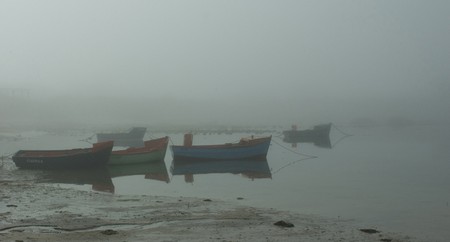

Jacobsbaai
Within 40 km of Jacobsbaai
Accommodation?
We’ve booked two self-catering cottages (sleeping six people each) and a conference room at the ‘Weskusplek’ in Jacobsbaai for that long weekend.

Each cottage costs R900 per night taken. In addition a cottage for two can be booked at R580 per night, not including breakfast.
There is a little restaurant – the only one in Jacobsbaai – with a beautiful view over the bay.
The conference room will be ideal for AV workshops and get-togethers in the evenings.
This outing from Thursday 24 – Sunday 27 September is planned for all HPS members! Please ensure your place by an early booking with Paddy!!! A % deposit is required.
More detailed information will follow later.
Examples of “third images”
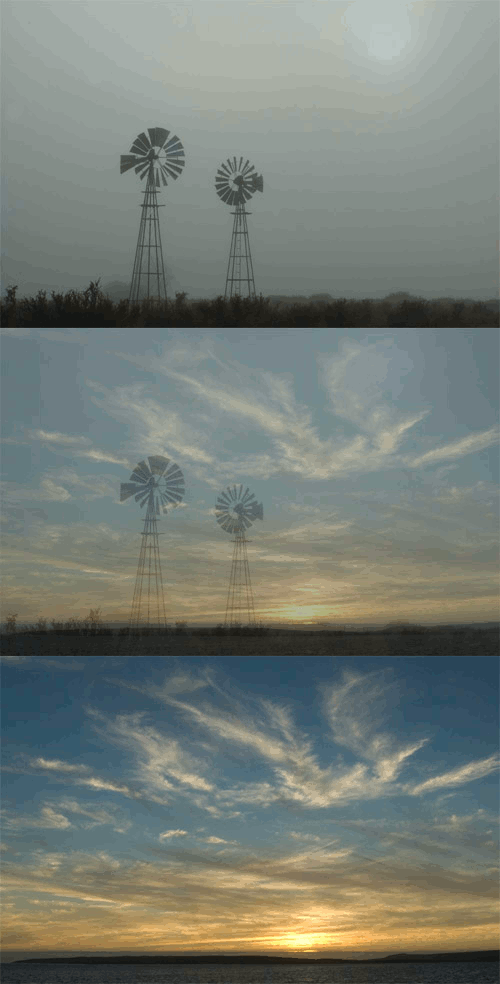
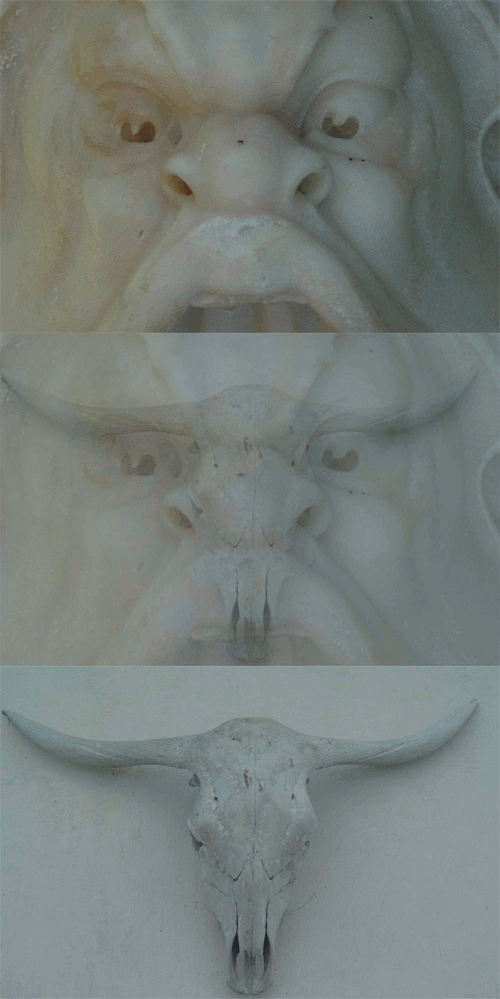
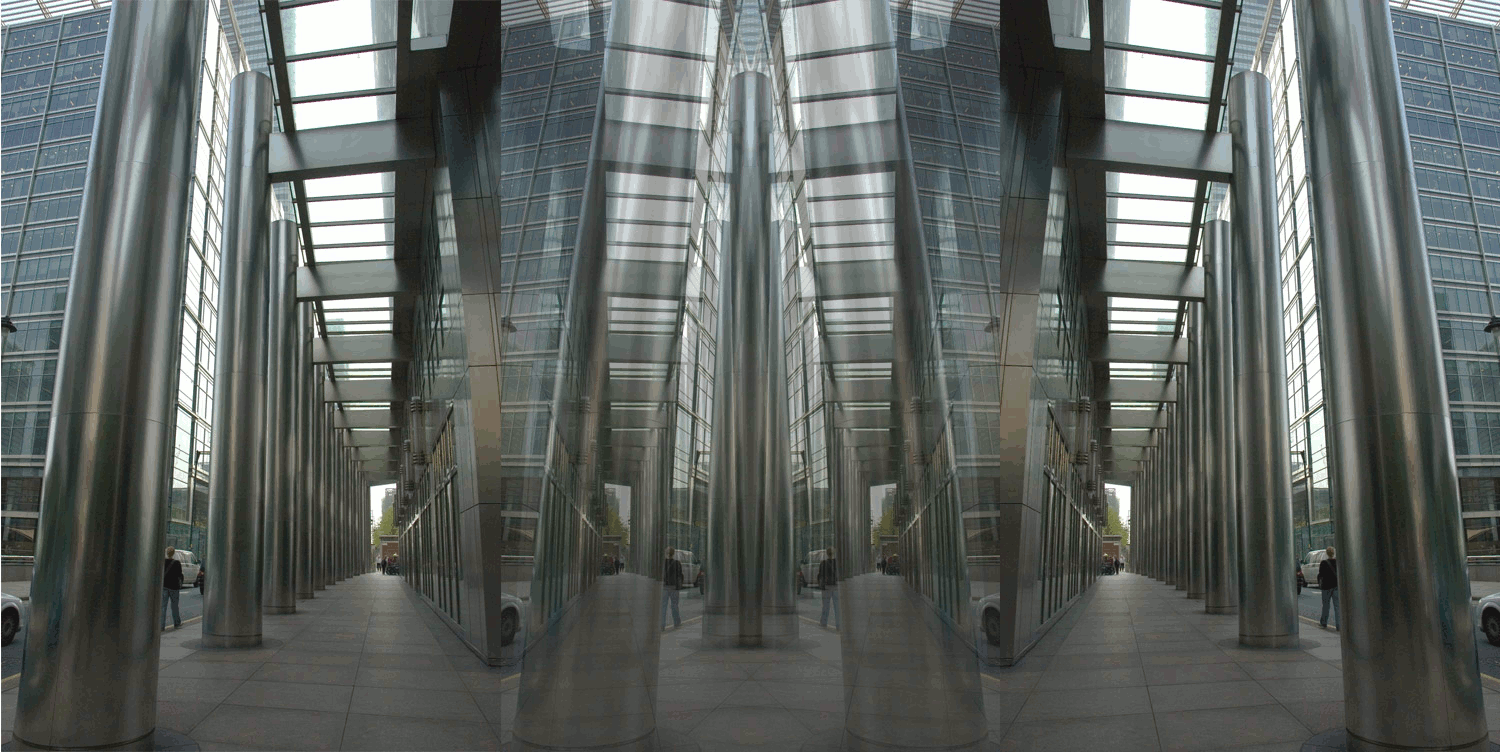
Content for this post supplied by Irmel Dunaiski.
Dear Chairpersons,
It has been week since I have been elected as your regional director. Firstly I would like to thank you for the entrusting me to fill this very important position and for your overwhelming positive response.
In the past there has been very negative vibes towards PSSA, and my aim is going to be to clarify all of this. I personally have been a member of PSSA for the past 35 years and will continue to be a member for as long as I live. I am not shy to say that through the PSSA I made my mark in photography. I don’t think we always appreciate the immense work that goes into running a society as the PSSA and for all those people who give a lot of their time organizing congresses, workshops and lectures, and that all to our benefit and the photography we do.
I believe that without PSSA we might as well pack away our cameras. Let us rather support PSSA by becoming full members and work together to make photography an even greater success. If there is any unhappiness or queries I would like to know about it, so we can work together to solve the problems for you.
On the 11th Feb. Hermanus and Helderburg are having a joint meeting which I will attend along with some of our members from Fish Hoek. I think this is a great idea for clubs to meet during the year and not only see each other at the interclub. I can’t help to think back to the years when we were like one big family of photographers.
We had our last interclub at Paarl, but there is some confusion of who is going to host it this year. We have lost track, and if we could get some indication who should be next, it will be appreciated. There has been a suggestion that we should have our interclub meetings if possible at a venue like Sanlam. They have all the facilities and I am sure that we, with a bit of help from our friends at Sanlam secure this venue.
It is encouraging to see how the standard of photography has improved and how the numbers in the clubs are growing again. After doing photography for more than 40 years I am glad that I can still participate in such a great hobby. Photography has always been a passion and a great part of my life and if I could encourage more photographers to feel the same I would have achieved my goal as your regional director.
I am looking forward to working with you.
Kind Regards,
Johan Kloppers
Eric Palmer made a number of pics (in between throwing buckets of water) which can be seen in his Flickr stream.
 Here is some info from Eric Palmer on what can be expected at the 15 February outing to shoot mountain bikers in Paarl. We will show a preview of the types of images that can be shot at the meeting on 11 February.
Ok, so we will meet right up at the gate to the Taal Monument. The “Playground” is quite a large area just below the monument & it can be a great feature in the BG of your shots. You don’t have to walk far to get to some really good opportunities, but the terrain is quite slippery gravel so advise to take hiking boots or comfortable shoes with good grip.
As far as camera equipment goes, just about all lenses from seriously wide & fisheye to about a 200/300mm. Doubt you would need anything much longer than that, but can give it a go if you feel strong enough to carry it. Flashes for close wide shots if you have one, not a necessity. Bring a few cards as you often shoot quite a lot more with the action than you would anywhere else. Make sure batteries etc are charged & cards formatted.
Being in Paarl it will most probably be pretty warm, so bring a hat, sunscreen & lots of water!!! Up at the playground there is very little shade & no shops, so bring all your nibblies & drinks with you. I would like to meet there between 8 & half past because of the heat & shoot up at the top until about 10am or so & if people are still keen to shoot & the riders aren’t dead by then we can move further down under the trees where it is more downhill racing trails rather than big jumps & drops, but is still a lot of good photo opportunities.Think that’s about it on the what to bring side & would just like to give a little warning as I don’t want any accidents. BE AWARE!!! These guys fly over things & down tiny paths & don’t want anyone in a collision. I will warn everyone when we are there, but in action photography (just like any other form of photography) you need to observe for a while before you start to shoot. Watch where the guys go & what lines they take so we can stay well out of their way & see where the main action is happening. I’m pretty sure the guys wont mind doing a few portraits too, the gear can look quite impressive & will be a nice change if the action gets too much for you.
Great, looking forward to it! Should be a good fun morning & the riders are keen too! Should have at least 20 guys there if not more.
Paddy is organising an outing to Jonkershoek on Sat. 21st Feb at 3pm – we will meet at the coffee shop at the entrance to the Reserve. Depending on time and inclination, we may move to the Strand for a few evening shots on the beach, and perhaps a snack afterwards.
The Kalk Bay Modern will present George Hallett’s exhibition from 21st February until 15th March. The gallery is situated on the first floor of the Olympia Building, 136 Main Road, Kalk Bay, and is open daily from 9.30am untl 5pm. Tel. 021 7886571.
‘Hallett is a Cape Town based photographer. Born in Hout Bay he taught himself the art, beginning his career as a street photographer. After establishing close associations with writers and artists he gave up his clerical job and became a staff photographer with a local newspaper. Hallett made a poignant personal document of District Six, a part of Cape Town that had been declared white, forcing all black inhabitants to be removed and their property destroyed. In 1970 he left South Africa to work for The Times of London. Hallett took a personal interest in the exiled South African artists living in Europe and his collection houses a strong selection of those artists. Hallett has taught photography in Europe, America and Africa and continues to take a motivated interest in community-based arts projects in our country. He returned permanently to South Africa in 1995. In 1997 he was jury member of the World Press Awards. Hallett is currently working on various personal projects involving the Red Cross Children’s Hospital, Muslim families in Cape Town, and preparing an exhibition on Black Life in the city during the 1970’s’.
When you send me a request for an invitation to our Flickr group, please make sure that you have made me a contact first. Flickr has a mechanism in place to prevent spamming through the group system by only allowing me to invite people that have me as a contact. Although I can also invite you via your e-mail address this is problematic as people sometimes use different e-mail addresses and if the address doesn’t match the one used to open your Flickr account you might still not be able to join the group, even after being invited.
February’s Fun Challenge is ‘Out of Place’ – just click on the ‘Helderberg’ Flickr site on the right-hand side of this page, and see what it’s all about!
Have a WordPress.com account? Log in now.

